How to Find Your Provider Taxonomy Code
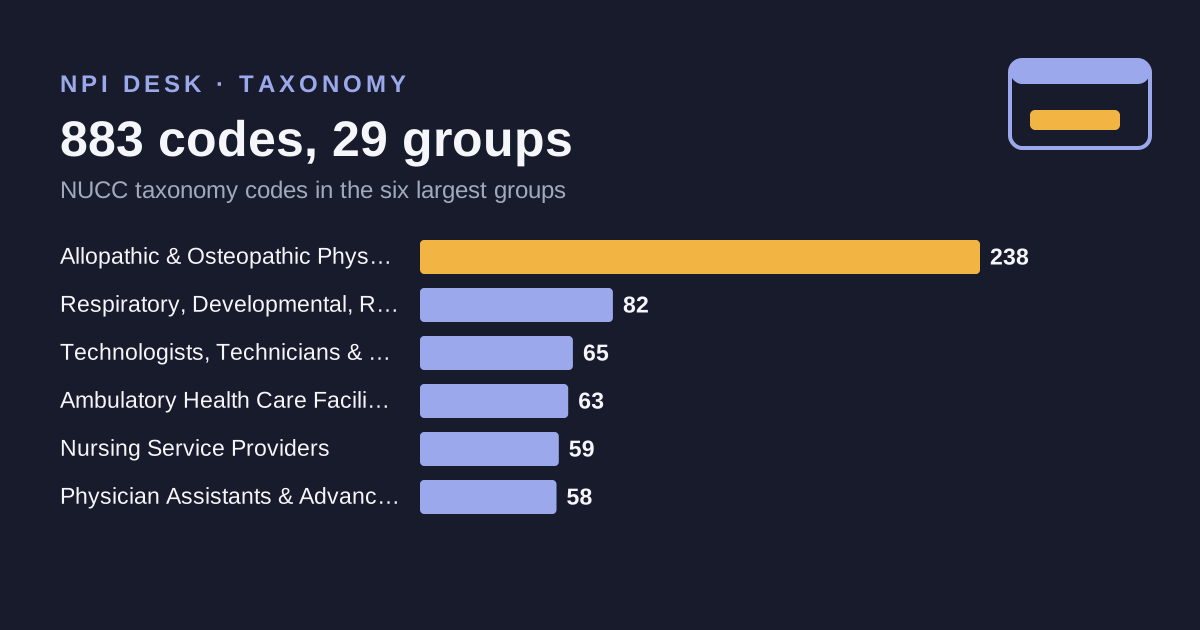
Your taxonomy code tells payers what kind of provider you are. It is chosen when you apply for an NPI, shown on your NPI record, and reported on claims. Getting it wrong is a common reason for claim denials, because payers check it against the NPI record and their own enrollment files.
Start from the tree
The NUCC code set has 883 codes in three levels:
- Group — the broad type of provider, such as "Allopathic & Osteopathic Physicians" or "Nursing Service Providers". There are 29.
- Classification — the profession or main specialty within the group, such as Family Medicine or Nurse Practitioner.
- Specialization — an optional narrower area, such as Acute Care under Nurse Practitioner.
Codes for individuals (698 of them) go on a Type 1 NPI; codes for organizations (185) go on a Type 2 NPI.
Choose the most specific code you are qualified for
Use a specialization code only when your training or board certification is specifically in it. Otherwise use the general classification code, which ends in 00000X. A family physician uses 207Q00000X; a family physician board-certified in sports medicine may use the sports-medicine specialization under Family Medicine as well, with one of the two marked primary.
Nurse practitioners show how the levels work: the general code is 363L00000X, and 17 more codes cover population foci such as family, pediatrics, psychiatric/mental health and acute care. A family nurse practitioner should use the family code, not the general one.
Check the Medicare side
If you bill Medicare, the taxonomy code should match your Medicare enrollment specialty. CMS publishes a crosswalk between the two, and each code page on this site shows the Medicare specialty it maps to. Not every code has one: about half of the taxonomy codes have no Medicare crosswalk entry, because Medicare does not enroll those provider types under their own specialty.
Change it when your practice changes
You can update the codes on your NPI record in NPPES at any time. If you add a certification or change your main area of practice, update the record, then your payer enrollments, so all three agree.
Use the taxonomy finder to search all 883 codes, or look up your NPI with the NPI lookup to see what is on your record now.
Questions
Where do I find my current taxonomy code?
Search your NPI in the NPI Registry. The record lists every taxonomy code on the NPI and marks one as primary.
Can I have more than one taxonomy code?
Yes. An NPI can carry several taxonomy codes, one marked primary. Claims should use the code that matches the service billed.